About us
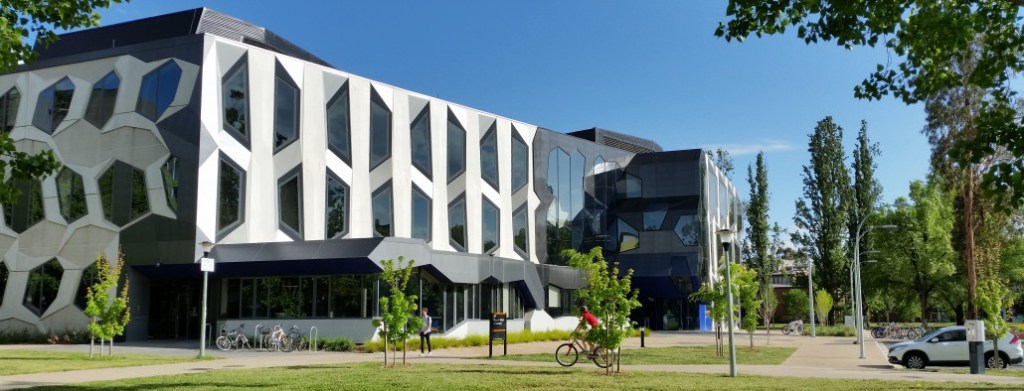
We are a research group specialising in supramolecular chemistry based in the Research School of Chemistry at the Australian National University in Canberra. Thanks for visiting – please have a look around and email Nick if you have any questions.
Recent news
Two papers in a week: Honours student Meabh’s work on dimethylamidinium networks is published in Cryst. Growth Des., and work that Nick contributed (a little) to during his mini-sabbatical in Sheffield that reports the first halogen-bonded nanosheets is published in Adv. Sci.
Michael McGuirk (Colorado School of Mines) and Nick wrote a tutorial review on supramolecular framework as part of an invited special issue of Chem. Soc. Rev.
Rosie publishes a paper in Angew. Chem. jointly with the Colebatch group showing that we can metalate our 6+ cages to give M3cage metallocages with coordinatively unsaturated metal ions. When we have an ethyl solubilising group we get the expected three-fold symmetric cages, but methoxy or propoxy solubilising groups give strange low symmetry metallocages (low symmetry in the solid state and in solution, even at high temps).
Jordan and Callum’s communication about a porous halogen-bonded framework assembled using ion pair templation is published in Angew. Chem. Jordan designed this system and then Callum made it during his MChem project visiting from Edinburgh. The framework is stable to solvent exchange and takes up iodine vapour.
Rosie and Petch publish a paper in CEJ showing that a simple bis-amidinium molecule can precipitate oxalate or terephthalate from water. It’s re-usable, selective, and works at sub-millimolar concentrations. This builds on our previous work showing we can remove sulfate from water.
A huge amount of work led by Emer and Rosie reports a new family of stable water-soluble hydrazone-based cages in JACS. These can be prepared on large scales and one of them selectively binds sulfate anions in water. We made these on scales up to 14 g over two steps with no chromatography needed and we think you could scale these up much more if you wanted to.
Welcome to Bailee who joins the group to start a PhD. Bailee previously did an undergraduate research project in the group in 2021 and BSc(Hons) joint between our group and Annie Colebatch’s group in 2022 before working at the ACT government forensics laboratory. She’s now back for a PhD on cages.
Jordan’s report of some very open (but not very stable) halogen-bonded frameworks is published in Cryst. Growth Des.
 The NWhite Supramolecular Chemistry Group